The Ultimate Bottleneck for Robotics: Trust
The trust layer for Robotics & Physical AI
Robotics won’t become part of everyday life simply because robots become more capable. It’ll happen when robots become trustworthy.
Scroll to read on.
Introduction
Trust sounds like a soft problem. It really isn’t. Trust is one of the hardest technical constraints in Physical AI. A robot can recognise objects, map a room, avoid obstacles and plan a path, yet still behave in ways people find awkward, unpredictable or unsafe.
That matters. A household robot that’s technically impressive but socially clumsy won’t be invited back into the home. A hospital robot that can’t read patient movement won’t be trusted near vulnerable people. A warehouse robot that moves efficiently but surprises workers will create risk, friction and resistance. A delivery robot that can’t negotiate shared space will be treated as an obstacle, not an assistant.
The adoption problem for robotics isn’t only performance. It’s trust.
SpatioTemporal exists to build the trust layer for Robotics & Physical AI. Not by building robots ourselves. Not by replacing perception or planning. And not by claiming that trust can be manufactured through branding, certification or reassurance alone.
Trust has to be earned through behaviour. For robots, that means understanding people well enough to act safely, predictably and naturally around them.
We don’t have a robotics problem. We have an adoption problem.
The field has made extraordinary progress. Robots can move with increasing dexterity. Vision systems can detect and classify objects with impressive accuracy. World models can simulate physical environments. Planning systems can generate actions across complex spaces. The hardware is improving. The software is improving. The underlying AI stack is improving.
And yet, outside tightly controlled settings, robots still struggle to operate comfortably around humans. That’s not because the robots can’t see us. In many cases, they can. The harder problem is that they don’t understand us.
They don’t understand hesitation. They don’t understand uncertainty. They don’t understand the small shift in movement that says a person is about to step sideways, cut across, stop suddenly, yield, commit, or change their mind.
Humans read these signals constantly. We do it in traffic, on footpaths and sidewalks, in shopping centres, kitchens, factories, hospitals and train stations. We avoid collisions not because we’re calculating perfect trajectories, but because we’ve spent our whole lives learning the grammar of movement.
Robots haven’t. That gap is becoming the real adoption bottleneck.
A robot that can see but can’t read human intent will either move too aggressively, creating danger, or too conservatively, creating friction. It may stop when it should proceed. It may proceed when it should wait. It may replan awkwardly, freeze in shared spaces, or behave in ways that make people step back rather than relax. This is the very definition of something being ‘robotic’ – that it’s stilted / awkward.
Those behaviours erode trust. And once trust breaks, adoption slows.
Trust isn’t a feeling. It’s an engineering outcome.
People trust systems that behave consistently, predictably and appropriately under uncertainty. We trust a lift because it arrives, opens, closes and moves in ways we understand. We trust cars partly because a century of engineering, rules, signalling and safety systems has made their behaviour legible. We trust aircraft not because flying is simple, but because the whole system has been engineered to make catastrophic surprise rare.
Robots entering human spaces need their own version of that. Industrial robots solved trust by separation. They were fenced off, caged, isolated or kept within structured environments where humans didn’t need to interpret their behaviour moment by moment.
That won’t work for the next generation of robotics. A household robot can’t live behind a safety cage. A hospital robot can’t avoid patients. A humanoid assistant can’t be useful in a workplace if everyone has to pause, step back and wonder what it’ll do next.
Shared-space robots need to earn trust inside the interaction itself. That requires more than object detection. It requires human understanding.
Not a philosophical understanding. Not consciousness. Not emotion. A practical, behavioural understanding of how people move, what that movement signals, and what may happen next.
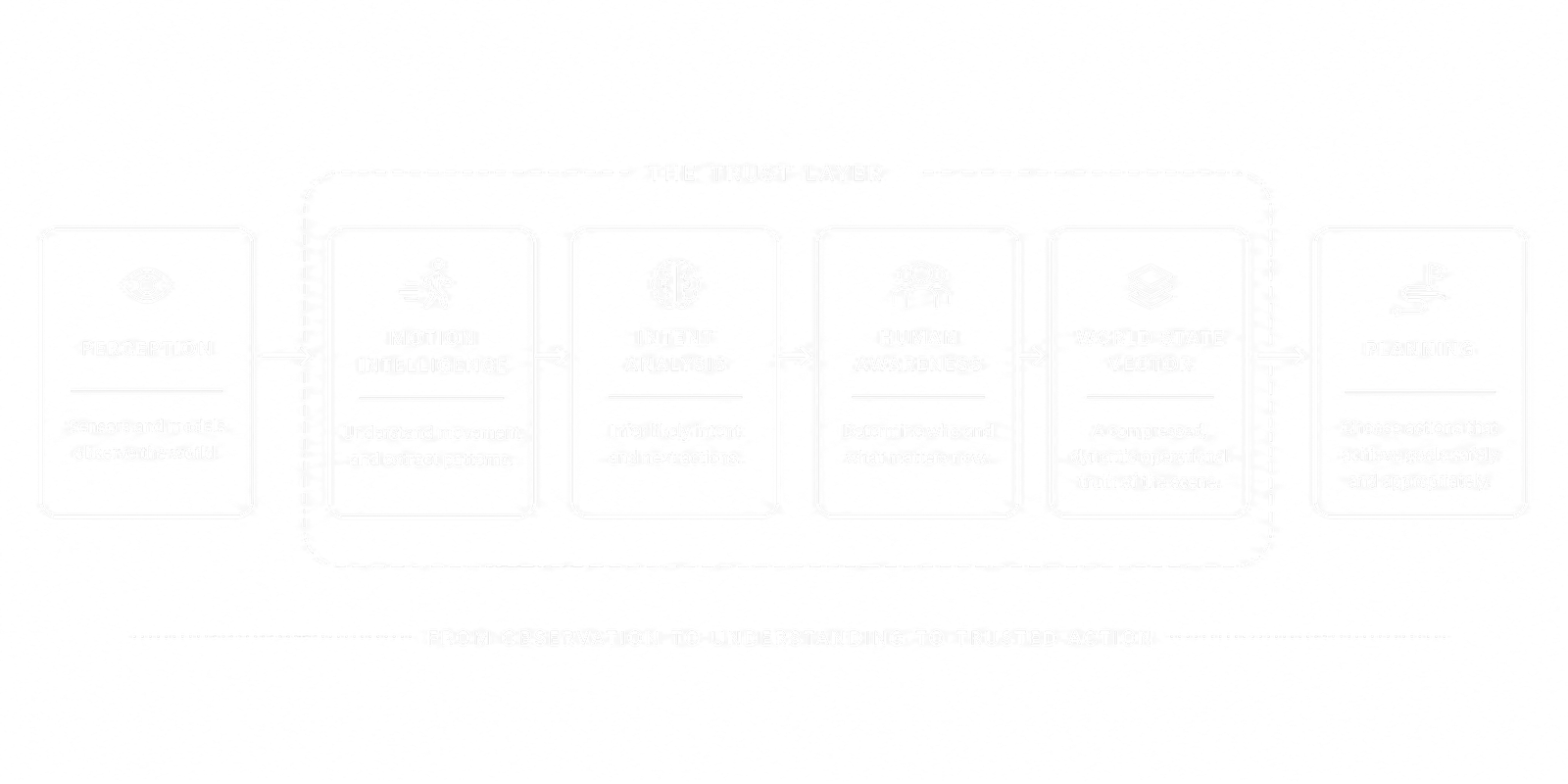
Humans reveal intent through movement.
Most human intent becomes visible before action is complete. A pedestrian doesn’t simply cross. They slow, orient, lean, hesitate, step, commit. A driver doesn’t simply merge. They drift, match speed, create a gap, test the lane, accelerate or withdraw.
A child doesn’t simply run into a robot’s path. They wobble, look away, shift weight, break rhythm, then move. A worker doesn’t simply enter a shared workspace. Their body turns first. Their pace changes. Their attention moves. Their path starts to form before the action is obvious.
Intent leaks into the physical world through motion.
That’s the signal we’ve focused on. Movement is universal. It appears before language. It crosses cultures. It shows up in vehicles, humans, animals, forklifts, robots, drones and crowds. It can be observed through cameras, sensors, simulation, tracking systems and other perception stacks.
More importantly, motion carries structure. Speed matters. Direction matters. Acceleration matters. Jerk matters. Relative distance matters. So do hesitation, commitment, drift, convergence, divergence and timing.
Humans don’t need to name these signals to use them. We compress them instinctively. We feel when someone is about to cut across us. We sense when a driver hasn’t seen us. We know when a cyclist is unstable, when a shopper is about to turn, when a crowd is beginning to compress.
That isn’t magic. It’s compressed spatiotemporal prediction, learned through embodied experience. Robots need an engineered version of that capability.
Motion Intelligence is where trust begins.
SpatioTemporal’s first technical focus is Motion Intelligence. Instead of treating motion as a secondary by-product of perception, we treat it as a first-class signal.
We compress space and time into motion tokens: compact, machine-readable representations of how things move. These tokens allow a model to learn patterns of movement over time, much like language models learn patterns across text.
But the goal isn’t to describe movement for its own sake. The goal is to help machines infer intent, anticipate interaction and support safer behaviour in shared human environments.
Perception tells a robot what’s there. Planning tells it what to do. Motion Intelligence helps it understand what’s about to happen.
That understanding is the beginning of trust, because humans don’t trust robots that merely avoid them at the last moment. We trust robots that appear to understand the situation early enough to behave naturally.
A robot that yields smoothly earns more trust than one that stops abruptly. A robot that adjusts before a conflict emerges earns more trust than one that waits until the risk is obvious. A robot that moves as if it understands human intent becomes easier to work around.
Motion Intelligence isn’t about making robots cleverer in the abstract. It’s about making their behaviour more legible, safer and more trustworthy to the humans around them.
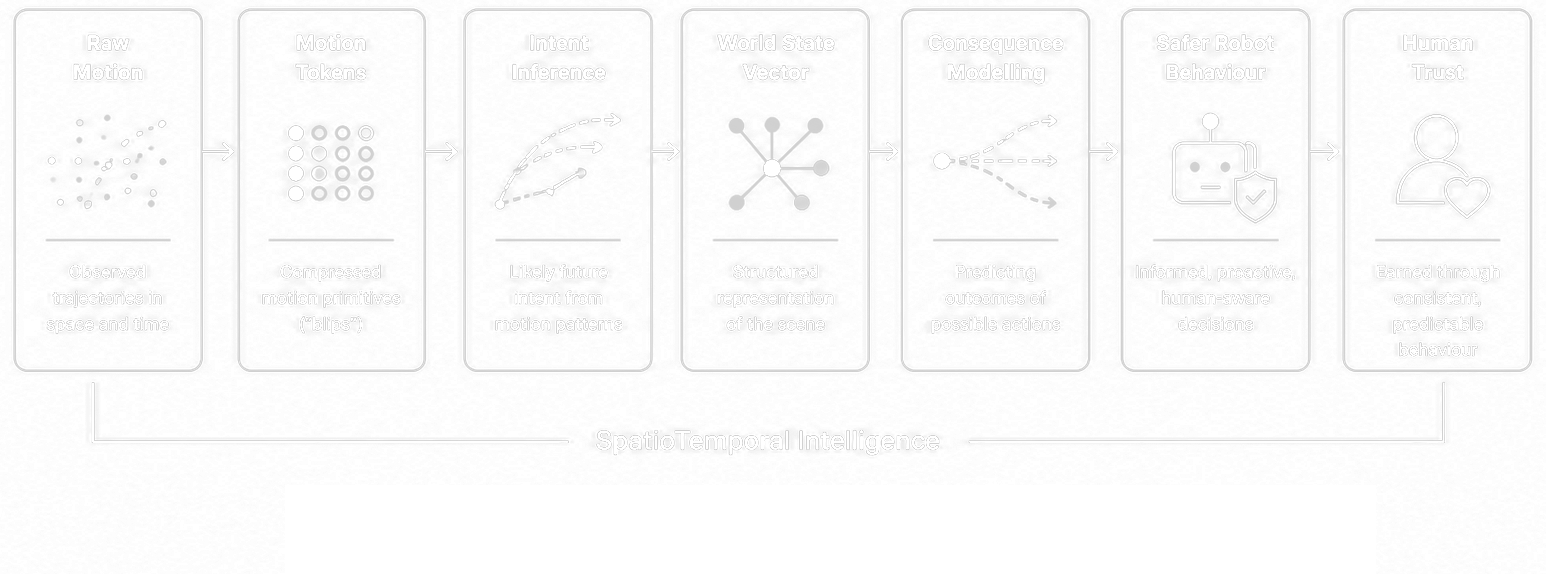
The trust layer sits between seeing and acting.
Today’s autonomy stacks are often described in terms of perception and planning. Perception answers: what is here? Planning answers: what should I do? But in human environments, another set of questions sits between those two.
- What does this movement mean?
- What is this person likely to do next?
- Which agents matter most right now?
- What interaction is forming?
- What happens if I move?
These are trust-layer questions. They’re the questions a robot must answer before acting around people.
At SpatioTemporal, we see this layer as a family of related capabilities. Motion Intelligence is the first. It turns movement into tokens and learns the grammar of movement. Intent Analysis comes next, estimating what an observed pattern of motion suggests about future behaviour.
Human Awareness adds relevance. It helps determine which people, agents or objects matter most to the robot’s current situation. The World State Vector brings those signals together into a compact, dynamic summary of the scene: who’s present, how they’re moving, what they may do next, which interactions matter, and where attention should be focused.
Temporal Intelligence then extends the system forward. It supports future-state prediction, causal reasoning and consequence modelling: not just what’s happening, but what may happen next, and what may happen if the robot acts.
Together, these capabilities form the trust layer. Not as a single product feature, but as an intelligence layer that helps robots behave in ways humans can trust.
Read more at State is all you need
Trust needs to be measured differently.
Robotics often measures progress through technical benchmarks: detection accuracy, path efficiency, collision rates, task completion, planning speed and energy use. These matter, but they don’t fully capture the adoption problem.
A robot can complete a task and still make people uncomfortable. It can avoid collisions and still move awkwardly. It can be technically safe and still behave in ways that humans don’t trust.
The next generation of robotics needs stronger measures for human-centred behaviour.
- How early did the robot detect intent?
- How smoothly did it yield?
- How often did it replan?
- How much uncertainty did it create for nearby humans?
- Did it reduce near-collisions?
- Did it behave consistently across similar interactions?
- Did people have to adjust around the robot, or did the robot adjust around them?
These are trust-layer metrics. They’re not soft. They’re behavioural. And they’ll matter more as robots move from factories into homes, hospitals, workplaces, schools, retail environments and public space.
The ultimate benchmark won’t be whether a robot can operate near people once. It’ll be whether people are happy for it to keep operating near them.
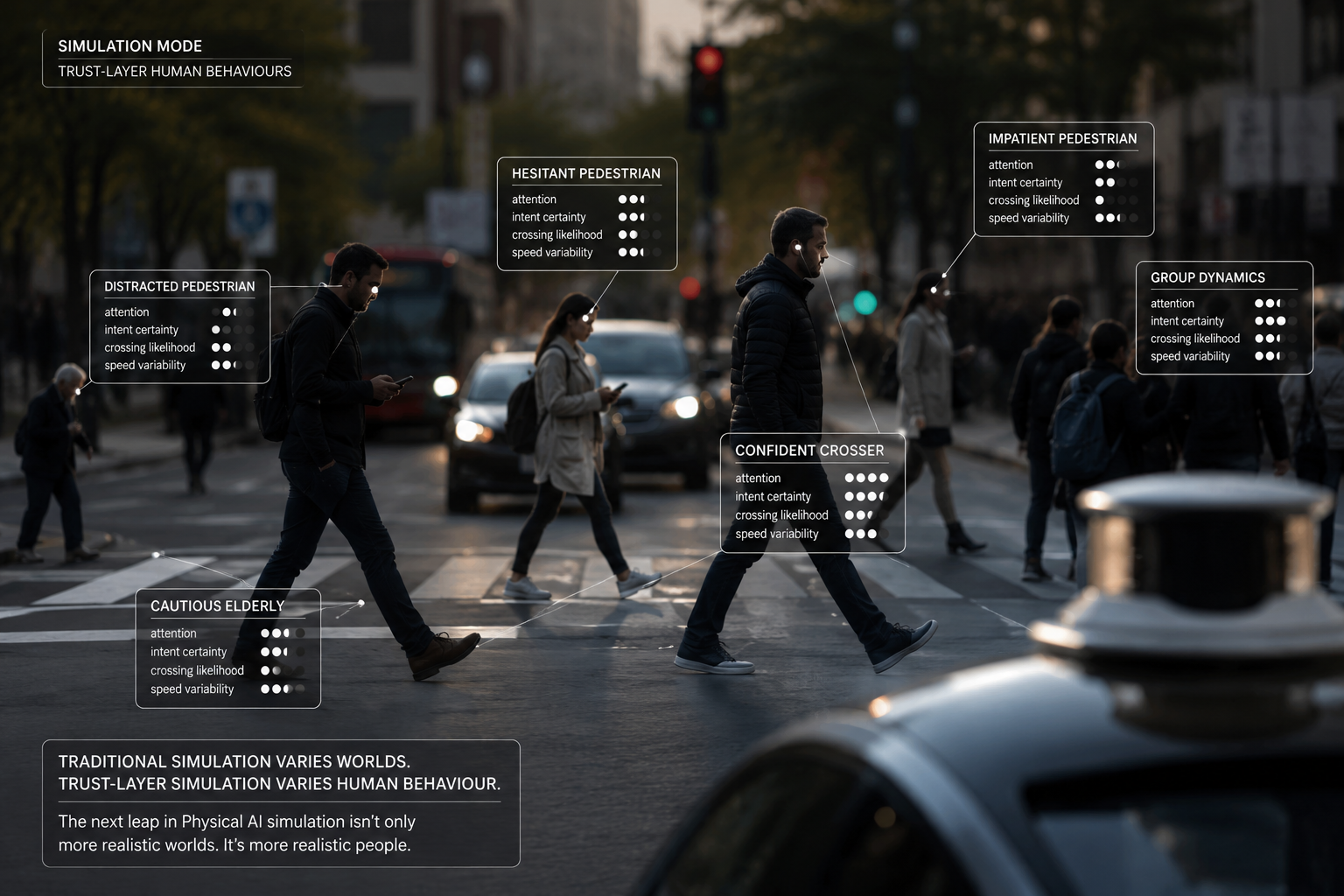
Simulation must learn people, not just worlds.
Physical AI is increasingly trained and tested in simulation. That makes sense. Simulation allows scale, safety, repeatability and controlled variation. But most simulation work still focuses on varying the world.
Lighting. Weather. Layout. Objects. Surfaces. Camera angles. Obstacles. Those variations are useful, but they’re not enough. Robots don’t only need to train across varied worlds. They need to train across varied people.
- Hesitant people.
- Distracted people.
- Confident people.
- Impatient people.
- Children.
- Elderly people.
- Crowds.
- Workers.
- Cyclists.
- Drivers.
This is where the trust layer becomes useful in two directions. Outside-in, it helps robots interpret human movement in the real world. Inside-out, it can help simulations generate richer, more varied human behaviour.
That matters because the sim-to-real gap isn’t just visual. It’s behavioural.
A robot trained on visually realistic environments may still fail if the people inside those environments move in simplistic, predictable or overly rational ways. Trusted robotics needs simulation that reflects how humans actually behave: not perfectly, but richly enough that robots learn to handle ambiguity before they meet it in the real world.
Why this matters now.
Robotics is entering a new phase. For decades, robots mostly lived in controlled environments. They were valuable, but isolated. They served manufacturing, logistics and specialised industrial roles where uncertainty could be reduced and human interaction could be limited.
That boundary is shifting. Humanoid robots, service robots, autonomous vehicles, mobile manipulators and general-purpose robotic systems are moving toward the open world.
The robot no longer needs to understand only the task. It needs to understand the people around the task.
This is where trust becomes the adoption bottleneck. A robot can be impressive in a demo and still not be trusted in a home. A robot can work in a lab and still fail in a hospital corridor. A robot can navigate a warehouse and still be rejected by workers if it behaves unpredictably.
Capability creates attention. Only trust creates adoption.
That’s why the trust layer matters. It’s not a branding layer, a compliance layer, or a promise printed on a website. It’s the intelligence required for robots to act around humans in ways humans can accept.
What SpatioTemporal is building.
SpatioTemporal builds foundation models for Physical AI. Our starting point is Motion Intelligence: a model that learns the grammar of movement by compressing space and time into motion tokens. That gives machines a compact way to understand how things move, how movement changes, and how those changes may reveal intent.
From there, we’re building toward a broader family of SpatioTemporal Intelligences:
- Motion Intelligence to understand movement.
- Intent Analysis to infer likely future behaviour.
- Human Awareness to identify which agents matter.
- World State Vectors to represent the dynamic situation.
- Temporal Intelligence to predict future states and model consequences.
The goal isn’t to replace the robot. It’s to give robotics systems a trust layer: a reusable, integrable capability that sits between perception and planning, helping robots understand people before they act.
This makes SpatioTemporal complementary to existing autonomy stacks, simulation platforms and robotics foundation models. Perception still matters. Planning still matters. Control still matters. But as robots enter human environments, those systems need a richer understanding of motion, intent and consequence.
That’s the layer we’re building.
Core thesis
Robots won’t become ubiquitous because they become more intelligent in the abstract. They’ll become ubiquitous when people trust them. And people won’t trust robots just because they can see, speak or move. People will trust robots when they consistently behave as if they understand the humans around them.
That requires a new intelligence layer. One that reads movement, infers intent, models consequence, supports safer behaviour, and helps robots earn trust through repeated interaction.
Trust is the adoption problem for robotics. Motion is the first signal of human intent. SpatioTemporal is building the trust layer for Robotics & Physical AI.